Biography
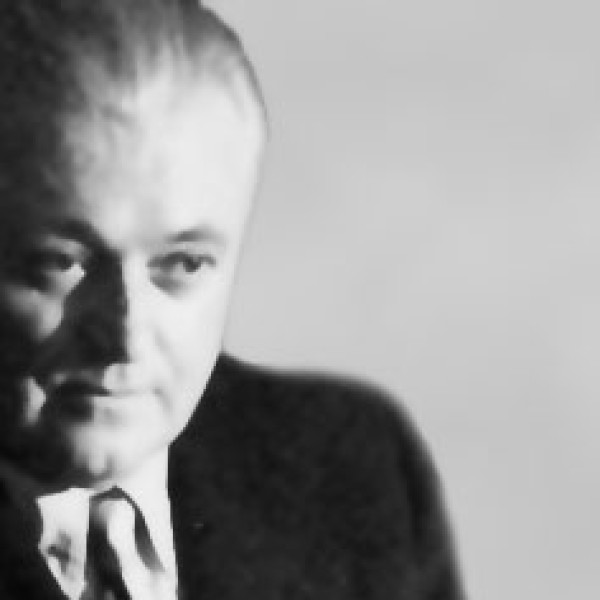
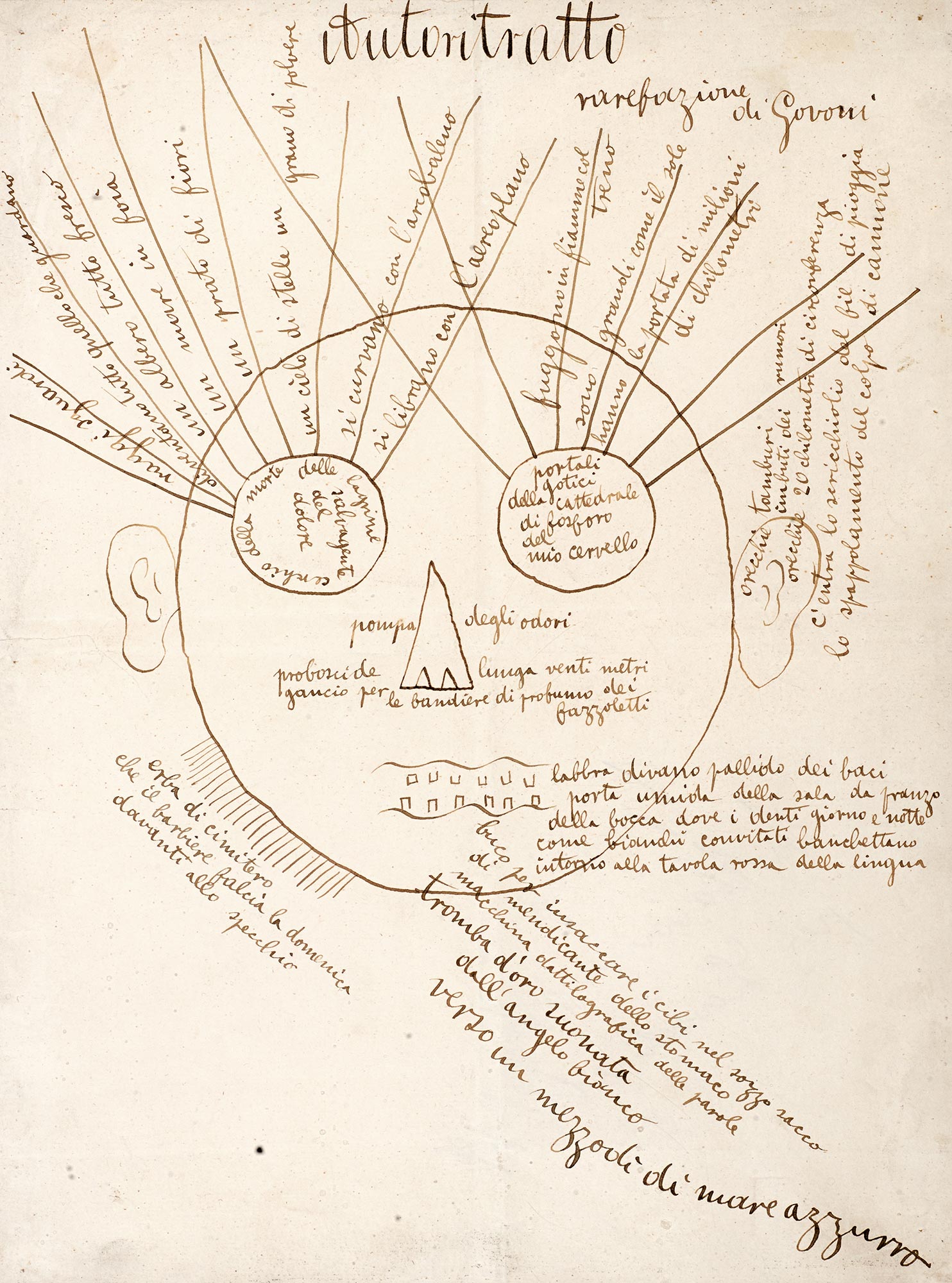
Born in Ferrara, Govoni (1884-1965) was a poet whose work was initially Symbolist in character. He was associated with Futurism during the movement’s early years, but this proved to be only a fleeting affiliation, represented by volumes such as Electrical Poems (1911-14) and Rarefactions and Words in Freedom (1915).
The latter was Govoni’s most radical Futurist work, being entirely handwritten and characterised by a highly original interplay between text and imagery. During the Fascist era he occupied an official role within the National Union of Authors and Writers, where he once again came into contact with the Futurist leader, F. T. Marinetti. Yet Fascism was to blight Govoni’s life with tragedy.
On 24 March 1944 his son Aladino, a member of the Resistance, was one of 335 individuals murdered by Nazi forces in the infamous massacre at Rome’s Fosse Ardeatine. Two years later, Govoni wrote a moving elegy titled Aladino: Lament for my Dead Son in his memory.
Artworks in the collection
Exhibitions featuring Corrado Govoni
Breaking Lines
.jpg)
A Decade of Discovery: Ten Years of the Estorick Collection
I cordai e la pioggia
Sopra le vecchie mura
due cordai torcevano la corda
lentamente, rinculando,
sotto la pioggia di primavera.
Non erano cordai
ma strani parrucchieri.
Pettinavano dolcemente
e torcevano in fluide trecce
i capelli di pioggia delle nuvole
indolentemente sdraiate
davanti ad uno specchio d'acqua
su cuscini d'azzurro altissimi
nel fresco e soffice divano d'una prateria.
Corrado Govoni
The rope makers and the rain
Up on the old walls
two rope makers were twisting rope
slowly, stepping backwards
in the spring rain,
not rope makers
but strange hairdressers,
combing gently,
wringing smooth plaits
in the hair of the rain of the clouds
that lazily laid
in front of a water mirror
on very high cushions of blue
on the fresh, soft sofa of a meadow.
Translated by Chiara Salomoni
(first published in print in The Rialto Number 98 Summer 2022)
---
L'arrotino e l'arcobaleno
Passando per il borgo
appena era cessato il temporale
dietro una casa vidi un arrotino.
La vecchia casa nera era il castello
con i suoi stracci sforbiciati
di vestiti pendenti alle finestre;
una gronda versava l'acqua sulla cote enorme
d'un rotondo pozzo di sasso
su cui il vecchio chino
aguzzava le forbici e i coltelli
e diaboliche falci
che sprizzavan scintille come lampi
che incendiavano l'umido orizzonte
facendo andar velocemente con il piede
la ruota sgocciolante dell'arcobaleno.
Corrado Govoni
The knife grinder and the rainbow
Passing through the village
just after the rainstorm
I saw a knife grinder behind a house.
The old black house was a castle
with its trimmed rags
of garments hanging from the windows.
A gutter was pouring water on the huge whetstone
of a round stone well
where the bent old man
sharpened scissors and knives
and terrifying sickles
bursting with sparks like a flash of lightning
that set the humid horizon alight,
using the foot treadle fast
to spin the dripping wheel of the rainbow.
Translated by Chiara Salomoni
(first published in print in New Humanist Autumn 2022)
---
Amanti
Un gnomo che distilla goccia a goccia
in un diafano fiore a imbuto
(gli pende alla cintura il lanternino
di ferro battuto
d'una lucciola
in cui funghisce un verde lumicino)
un antichissimo chiaro di luna,
che due primi amanti
su un terrazzo di marmo in riva al mare
bevono voluttuosamente
golosamente
nel doppio e lungo calice d'un bacio.
Corrado Govoni
Lovers
An elf distils
a very ancient moonlight
drop by drop
into a delicate funnel-shaped flower
(the small wrought-iron lantern
of a firefly hangs from his belt
where a green small light mildews)
then two new lovers
drink it sensually
greedily
on a marble balcony by the sea
in the double, long goblet of a kiss.
Translated by Chiara Salomoni
(first published in print in Oxford Poetry issue 096 Winter 23/24)
---
Felicità
Non so perché,
questa mattina son felice.
Ho forse udito per le vie del borgo
la voce del postino?
Aprendo la finestra verde
ho sentito che sono nati i rondinini?
Ho visto i gusci d'uovo sopra il marciapiede?
Ho ascoltato il maialino
grugnire contro l'uscio del porcile
dalla gioia sentendo mia madre
che attraversava il cortile
con la secchia di broda calda?
Ho visto la moglie del boaro
cavar dal forno
le croci rosee del pane?
O i buoi bianchi
che tornavano dai campi
col carro rosso pieno di lupinella?
O il venditore ambulante
che pesava sull'aia a un contadino
le ciliegie nella sua bilancia tremante?
È arrivato l'arrotino
col suo umido castello?
Dietro il fienile il cordaio
ha drizzato il suo mulinello?
Sono felice
forse perché laggiù lontano
il cuculo, questo grigio gabbiano
del mare verde oscuro
della canepa
s'interroga da sè e si risponde,
perché le spighe del grano maturo
sono come treccine bionde.
Corrado Govoni
Happiness
I don't know why
but I'm happy this morning.
Did I maybe hear the postman's voice
out and about in the streets of the hamlet?
Did I hear young swallows had been born
when I opened the green window?
Did I see egg shells on the pavement?
Did I hear the piglet
grunting with joy
at the door of the sty
when it heard my mother
crossing the yard
with a bucket of warm slops?
Did I see the cowherd's wife
with the bread's pinkish crosses
fresh from the oven?
Or did I see white oxen
back from the fields,
the drawn red cart loaded with sainfoin?
Did I see the peddler
weighing the cherries
on his trembling scale in a farmyard?
Is the knife grinder here
with his damp castle?
And did the rope maker straighten
his knot behind the hayloft?
Maybe I'm happy
because far away over there
the cuckoo, this grey seagull
of the overcast green sea
of hemp fields,
asks, and replies to itself,
why the spikes of ripe corn
are like little blonde plaits.
Corrado Govoni
Translated by Chiara Salomoni
(first published in print in New Humanist Spring 2025)
---
La danza
Una canzonettista ha appena finito
di cantar con le sue stupende gambe
calzate di viola
una romanza appassionata e frivola,
e il premere del dito in un bottone
fa il buio nella sala.
Un mio vicino accende la sigaretta
con un lampo vivissimo.
E là in fondo i lumi della ribalta
s'aprono ad uno ad uno rossi e verdi
con la meraviglia con cui si cercano
dei fiori in un prato:
eccone uno, un altro, un gruppo intero,
cento, mille.
E una nebbia di luce
sprofonda un panorama d'alberi turchini
in una radura umida;
uno zampillo di violino
ed ecco un'ombra informe scivolare sul tappeto.
È un turbine di vento
che avvolge e trascina delle foglie morte
è una nuvola d'odore che danza
è un gomitolo vertiginoso di luci prismatiche.
Le foglie cadono, la nuvola si fonde,
il gomitolo si sfalda: ignuda! ignuda!
e tutta lilla coi capelli verdi,
è la nudità calda che danza,
la voluttà che si protende e s'offre
la lascivia che striscia si sottrae
respinge attrae.
È così leggiera e vaporosa
che sembra con un soffio debba spegnersi
come una fiamma.
S'alza e s'abbassa come uno zampillo,
s'apre e si chiude come un ventaglio,
si stira come una fisarmonica.
Ma che cosa raccoglie con le mani
chinandosi? Che cosa sbatte e gonfia?
Forse i suoi petali sfogliati?
Forse monta del chiaro di luna?
La sua testa è un gran fiore a spirale
che dei motori invisibili
dal ronzio di violìni
fanno girar vertiginosamente
sopra il compasso
delle gambe di gomma lunghissime, folle.
D'un tratto ecco è sparita
è svanita per sempre;
da una folata di musica
è stata soffiata via
(resta solo nell'anima il baglior d'un lampo
una pallida scia)
come un colpo di vento
che distrugge in un attimo e disperde
nel turchino del cielo e nel verde del prato
un soffione d'argento.
Corrado Govoni
The dance
A crooner's just finished
to sing a passionate and shallow romance,
her beautiful legs with purple tights on,
and a finger, pressing a button,
brings darkness in the hall.
A man next to me lights up a cigarette
with a very sharp flash of lightning.
And down there the footlights,
red and green, switch on one by one,
with the same wonder someone looks
for flowers in a lawn:
here's one, another one, a whole bunch,
a hundred, a thousand of them.
And a fog of light
plunges a view of deep blue trees
into a damp glade;
there's a gush of violin
and a shapeless shadow slides on the carpet.
She's a whirlwind
that rolls up and lugs dead leaves,
she's a cloud of smell that dances,
she's a giddy yarn ball of prismatic lights.
The leaves fall, the cloud merges,
the yarn ball crumbles: naked! naked!
and she's all lilac with green hair,
she's the hot nudity that dances,
the pleasure that leans forward and offers itself,
the lasciviousness that shuffles and escapes,
she repels and charms.
She's so light and fluffy
that it seems she will die out with a puff
like a flame.
She rises and lowers like a gush,
she opens and closes like a fan,
she stretches like an accordion.
But what does she pick up bending
with her hands?
What does she shake and blow up?
Maybe her stripped petals?
Maybe the moonlight arrival?
Her head is a big twisted flower
whose invisible engines,
with the buzzing sound of violins,
dizzily wind
some very long rubber legs
above the calliper, out of control.
Suddenly, she's gone,
she's vanished forever;
she's been blown away
by a gust of music
(a flash of lightning, a pale trail of it, only remains
in the soul)
like a blow of wind
that destroys instantly and scatters
a silver dandelion
in the blue of the sky, in the green of the lawn.
Corrado Govoni
Translated by Chiara Salomoni
(first published in print in Poetry Salzburg Review No. 43 Winter 2025/2026)
---
Povertà
Quando non avrò più niente
allora sarò povero povero,
più della chiocciola
che gira con il suo castello
come l'arrotino,
più del rospo che prende il sole
come un lebbroso senza fame
sul marciapiede, contro il muro.
Ma che cosa ha la lucciola cerinaia?
E non è povero
anche l'usignuolo emigrante?
Penso che cosa farò,
che ci son tante cose
che possono far quelli
che non sanno far nulla
che non hanno più nulla.
Se facessi il lustrascarpe?
Potrei anche tenere
una cassetta di candele….
Se imparassi a suonare l'organino?
Se facessi il pastore?
Deve esser bello mungere le pecore
portare in collo
i belanti agnellini
piantar lo stazzo nel chiaror di luna.
Andrei col gregge per le vie maestre,
mi lascierei crescere la barba,
porterei il lunghissimo mantello
di pesante bigello,
farei la calza in mezzo ai prati,
andrei a vender la ricotta ed il formaggio,
avrei un cane
che mi vorrebbe bene.
Non potrei fare lo spazzino?
Andare
di paese in paese
con la mia mercanzia;
specchi tascabili,
pettini, spilli, nastri, fazzoletti, saponette,
poveri oggetti di chincaglieria;
contrattare con le ragazze
bramose intorno al sacco aperto,
tirare il soldo,
fare qualche regalo
ai clienti fedeli.
E gettar la mia voce triste
per la campagna:
- Lo spazzino! spazzino!…
Esser fratello dell'arrotino
dello spazzacamino del magnano
dello zingaro del bottaio ….
Dormir la notte in un fienile
mangiare sopra un paraccarro
riposare dietro una siepe in fiore….
E salutare con la mano i mendicanti,
come dei vecchi amici,
che vanno sotto le finestre
delle case
a fare i loro auguri.
Potrei fare lo strillone
in qualche gran città,
gridare le notizie di disgrazie
alle signore ch'escon dal teatro
con brividi di gemme,
correre anch'io
dietro una lucida carrozza
agitando il foglio bianco
come un fazzoletto per l'addio.
E se facessi i burattini
per i bambini?
Qualche cosa farò
venderò qualche cosa anch'io.
Quando non avrò più niente
allora sarò povero povero ….
Corrado Govoni
Poverty
When I'll have nothing left
then I'll be poor, so poor
poorer than the snail
that wanders with its castle
like the knife grinder,
poorer than the toad that sunbathes
like a leper without hunger
on the pavement, against the wall.
But what's wrong with the vesta firefly?
And is it not poor
also the emigrant nightingale?
I think of what I'll do,
of the many things
that people, that don't know
to do anything
that are left with nothing,
can do.
What if I were a shoeblack?
I could also keep
a candle box….
What if I learnt to play the barrel organ?
What if I were a shepherd?
It should be nice to milk the sheep
to have the bleating lambkins
round my neck
to set up the fold in the moonlight.
I'd go with my flock along the main streets,
I'd grow a beard,
I'd wear the very long cloak
of heavy homespun cloth,
I'd knit socks in the middle of the lawns,
I'd sell ricotta and other cheese,
I'd have a dog
that would be loyal to me.
What about being a dustman?
Going
from town to town
with my goods;
pocket mirrors,
combs, pins, ribbons, handkerchieves, cakes of soap,
cheap knick-knacks;
negotiating with the girls
eager for an open sack,
wrangling over a price,
the grant of some presents
to the regular customers.
And the scream of my sad voice
around the countryside:
The dustman! The dustman! …
In brotherhood with the knife grinder,
with the chimney sweep, the locksmith
with the gipsy, the cooper….
A sleep in a hayloft in the night,
a meal on a stone post,
a rest behind a hedge in bloom …
And a wave to the beggars,
like being old friends,
who go under the windows
of the houses
to wish people well.
I could be the newsvendor
in some big cities
screaming the bad news
to the ladies out of the theatre
wearing thrills of gems,
I'd run too
behind a polished horse-drawn carriage
shaking the white paper
like a handkerchief to wave goodbye.
And if I made the puppets
for the toddlers?
I'll do something
I'll sell something too.
When I'll have nothing left
then I'll be poor, so poor …
Corrado Govoni
Translated by Chiara Salomoni
(first published in print in Poetry Salzburg Review No. 43 Winter 2025/2026)
---
Venezia
Nella pioggia è fresca e scintillante
come un pesce d'argento
nella rete sgocciolante.
L'acqua sembra un miracoloso fiore verde
dai mille petali liquidi di canali
che sostengono la corona di rugiada gelata
della città.
Pali araldici,
fusi d'arcobaleni.
Gondole molli e profonde
come divani sugli elastici freschi dell'acqua.
La pioggia è come un'immensa e deliziosa chioma
che tutte le gondole si affannano a pettinare
col loro pettine pallido.
Le soglie sono untuose e lucide
come la coramella
su cui affilano i barbieri
i loro rasoi splendenti come specchi.
Hanno delle macchie tristi e amare d'umidità
come quelle che lasciano
le corone di fiori sulle tombe.
Il sole al crepuscolo si tuffa nella laguna
divinamente roseo e succulento
come una fetta di cocomero al marsala.
A mezzogiorno il colpo di cannone
è come un coltello che taglia a metà
un frutto maturo.
I colombi che mantiene tutto l'amore
del mondo in viaggio di nozze
fanno il solito giro intorno al campanile.
Una peota piena di bombe
verniciate come dei cocomeri
va verso Trieste.
Suonano delle campane fondenti,
verdi incudini dei lampi.
E palazzi, palazzi:
di pietra cotta e di marmo crudo,
leggieri ed elastici come nuvole,
freschi come specchi,
neri e bruciati come focolari,
aerei come ballerine,
avvelenati di belletti
come vecchie rugose cortigiane,
ripugnanti come maschere di cloroformio.
Sembrano impasti di sapone lilla
di cera rossa e di zucchero filato verde.
Il palazzo Dario
coi suoi piatti di Salome.
La Ca' d'Oro
nuvola d'odore roseo scolpito.
I fanali, soffioni d'argento.
Lampadari cereanti.
I pluviometri dei camini.
Il crepuscolo appuntato come una rosa
nei capelli umidi della sera
dal fermaglio d'oro verde del campanile.
Venezia, immensa maschera di cera
appesa dal carnevale agonizzante
al torbido e inquietante specchio della laguna,
cantina fosforescente
del chiaro di luna.
Corrado Govoni
Venice
It is fresh and flashing in the rain
like a silver fish
in the dropping net.
The water looks like a miraculous green flower
with a thousand liquid petals of canals
that hold the corolla of frozen dew
of the city.
Heraldic stakes,
shafts of rainbows.
Yielding and deep gondole
on the fresh elastic bands of water.
The rain is like vast and delicious hair
that all the gondole bustle about
running their pale combs through.
The buildings' entrances
are greasy and polished
like the strop
where the barbers sharpen
their bright razors like mirrors.
They have some sad
and bitter humidity spots
like the ones left
by wreaths of flowers on the graves.
The sun dives into the lagoon at dusk,
it is beautifully pinkish and succulent
like a slice of Marsala-flavoured watermelon.
The midday gunshot
is like a knife that cuts in half
a piece of ripe fruit.
The turtledoves have a usual tour
round the church tower,
carrying all the love of the world
on honeymoon with them.
A peota goes towards Trieste
loaded with bombs
painted like watermelons.
Some melting chimes ring,
they're green anvils
of the lightning.
And palaces, palaces:
made of fired bricks, of raw marble
light and resilient like clouds,
fresh like mirrors,
black and burnt like firesides;
they are airy like ballet dancers
and poisoned by embellishment
like old wrinkled-face courtiers,
they are loathsome like chloroform masks.
They look like mixture
of lilac soap, of red wax
and of green candy floss.
Palazzo Dario
with its Salome plates.
Ca' D'Oro
like a cloud with a pinkish carved smell.
The lights are silver dandelions.
The chandeliers are full of wax.
And look, the rain gauges of the chimneys.
The dusk is pinned like a rose
by the greeny-golden hairclip
of the church tower
in the evening moist hair.
Venice, vast wax mask
hung by the painful carnival
to the muddy and alarming lagoon mirror,
it is the luminous cellar
of the moonlight.
Corrado Govoni
Translated by Chiara Salomoni
(first published in print in Poetry Salzburg Review No. 43 Winter 2025/2026)
---
La primavera e la campagna
Io la vidi la vidi una mattina
coricata e distesa nella pianura
meravigliosamente bella
e il cuor mi trema ancora dalla gioia
come dopo i rintocchi una campana.
Allungava la gamba fresca e rotonda d'un fiume
fra merletti fragranti d'alberi;
là in fondo era la scarpetta
di camoscio bianco d'una casetta
allacciata di stringhe violastre di glicini;
sopra il ginocchio palpitava
la giarrettiera elastica dell'arcobaleno.
L'altra gamba non la vidi
ma la sentii viva
sotto la gonna a festa di contadina d'un prato
tutta intessuta di fiori
delle più svariate gradazioni
che andavano dal verde pallido
al più carico azzurro.
La sua chioma era quel bosco folto laggiù
che pettinava voluttuosamente
il pettine fluido della pioggia;
il vento era il profumo snervante
che si sprigionava
da quella massa miracolosa.
Le sue braccia si stendevano lontano ignude
con ascelle di messi bionde;
nell'indice di latte d'una strada
aveva il cammeo
d'un mendicante con l'ombrello rosso, al mignolo
l'anello rubinato d'un ponte nuovo.
La sua collana di perle era una cascata,
la fibbia rappresentava un aratore
con la sua lunga doppia fila di buoi.
La faccia era invisibile
tutta divorata dal suo sorriso
ch'era una vasca che specchiava il cielo e il vento verde.
Due colline turgide e rosee
tra veli spumanti di nuvole
erano le mammelle provocanti.
Io la vidi io la vidi
mentre agitava in segno di saluto
il lungo fazzoletto d'un bucato
ad uno che s'allontanava
su un treno che sbuffava e scalpitava
al segnale di partenza dato da un cuculo.
Corrado Govoni
The spring and the countryside
I saw her, I saw her one morning
lain down and stretched out on the plain,
a marvel of beauty,
and my heart still vibrates with joy
like a bell after chiming.
She stretched out the fresh, plump leg of a river
among fragrant laces of trees;
over there was the white suede tiny shoe
of a little house
laced with lilac shoe strings of wisteria;
the elastic garter of the rainbow
beating above her knee.
I didn't see the other leg
but I felt it was alive
under a farmer's Sunday skirt
of a lawn
all spun with flowers
the most varied shades,
from pale green
to the darkest blue.
Her hair was those deep woods over there
through which she would sensually run
flowing comb of rain;
the wind the enervating scent
that exhaled
from that miraculous body.
Her bare arms stretched out far away
with armpits of blond crops;
on the milky index finger of a road
she was wearing the cameo
of a beggar with a red umbrella,
and on her little finger
the ruby ring of a new bridge.
Her pearl necklace was a waterfall,
the buckle was a ploughman
with his long double lines of oxen.
Her face was invisible
wholly devoured by her smile,
like a pool mirroring the sky
and the green wind.
Two swollen and pinkish hills,
among veils foaming with clouds,
were her provoking breasts.
I saw her, I saw her
while she was waving
her long headscarf
fresh from a washing line,
to salute a man leaving
on a puffing and panting train
at the starting signal given by a cuckoo.
Corrado Govoni
Translated by Chiara Salomoni
(first published in print in Poetry Salzburg Review No. 43 Winter 2025/2026)
Chiara Salomoni is a poet and translator.
She is Italian and lives in London.
Her translations of poems by Corrado Govoni have been published in print and online.
All the poems written by Corrado Govoni and here translated are included in the collection L’inaugurazione della primavera (The spring opening) published in 1915.
Chiara Salomoni is a member of the Society of Authors and of poetry p f.
[https://societyofauthors.org/soa-member/chiara-salomoni/](https://societyofauthors.org/soa-member/chiara-salomoni/)
[http://www.poetrypf.co.uk/chiarasalomonipage.shtml](http://www.poetrypf.co.uk/chiarasalomonipage.shtml)
[https://wildcourt.co.uk/two-translations-of-corrado-govoni/](https://wildcourt.co.uk/two-translations-of-corrado-govoni/)
Artists in the collection
- Giacomo Balla
- Umberto Boccioni
- Massimo Campigli
- Carlo Carrà
- Giorgio de Chirico
- Gerardo Dottori
- Corrado Govoni
- Emilio Greco
- Renato Guttuso
- Giacomo Manzù
- Marino Marini
- Amedeo Modigliani
- Giorgio Morandi
- Zoran Music
- Ottone Rosai
- Medardo Rosso
- Luigi Russolo
- Giuditta Scalini
- Gino Severini
- Mario Sironi
- Ardengo Soffici