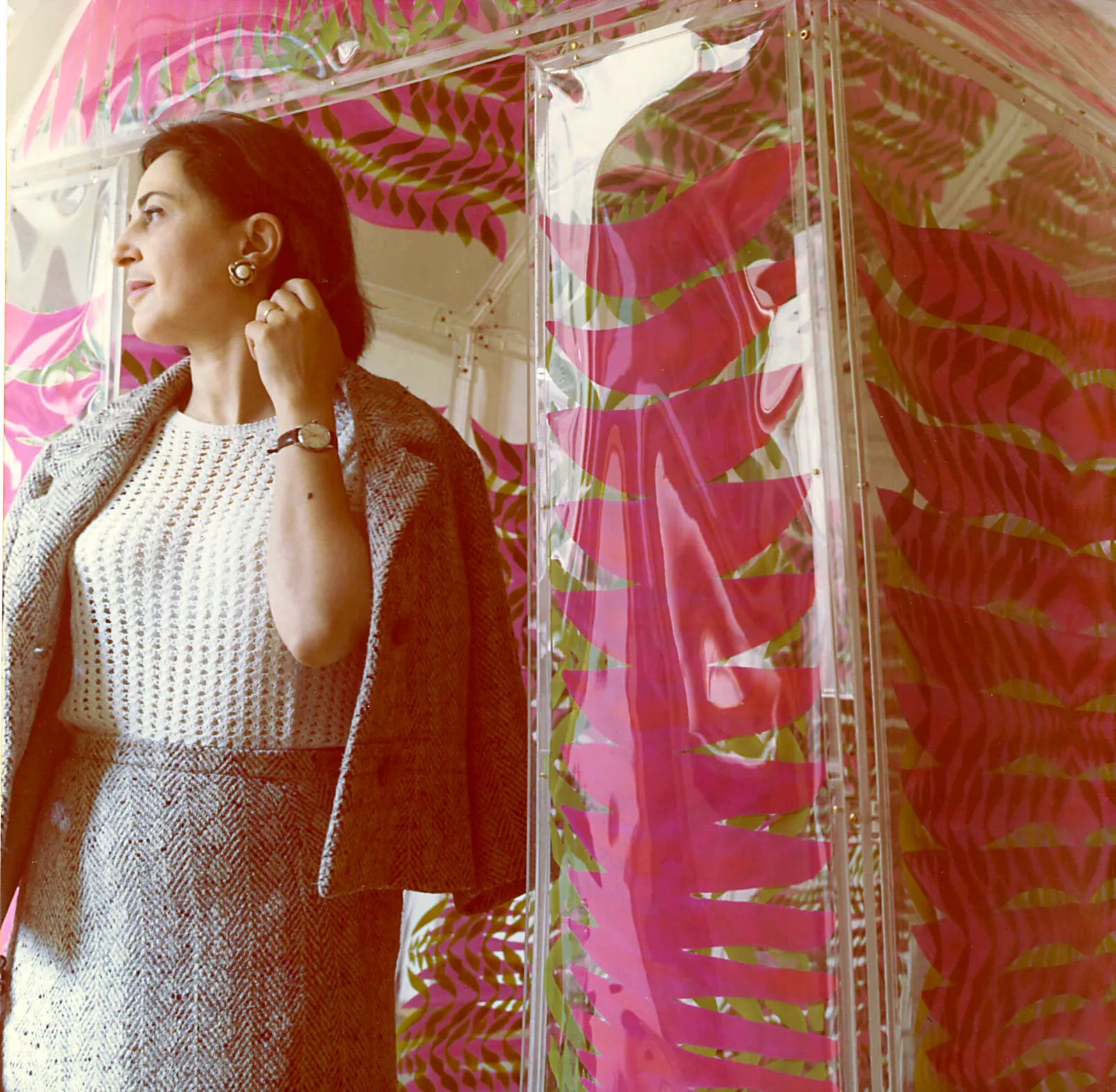
The Estorick Collection of Modern Italian Art and Compton Verney in Warwickshire present the first UK institutional project dedicated to Carla Accardi (1924-2014).
Shown across two exhibitions running at the same time, this collaboration offers a long-overdue chance to experience one of Italy’s most influential post-war artists in depth.
Accardi is central to the story of twentieth-century Italian abstraction, yet her work has never been seen in the UK at this scale. Across the two exhibitions, you can follow how she pushed painting in new directions, from the post-war avant-garde in Rome to bold colour, radical materials and works that bring light and space into play.
A defining idea in Accardi’s work is visual language. She created her own set of invented ‘signs’, marks that sit somewhere between writing and abstraction. For Accardi, these signs were not only a way of making images, they were a way of resisting fixed meanings and hierarchies of power.
One of her most important breakthroughs came with Sicofoil, a transparent industrial plastic. On this surface, light passes through and marks appear to float, so the work can feel open, shifting and alive to your movement in the space. These experiments helped expand what painting could be, developing more architectural qualities that explore space, light and colour.
Accardi’s art is also shaped by the politics of her time. Her practice connects to feminist debates in Italy in the 1960s and 1970s, including her involvement with Rivolta Femminile, and to bigger questions about who gets seen and who gets to shape the story of modern art.
Developed in close dialogue with the Accardi Estate, the project brings together significant loans and archival material.
Two exhibitions, one shared story
The two exhibitions are conceived together as one project, but they offer different ways into Accardi’s work.
At the Estorick Collection, the exhibition draws out themes and turning points in Accardi’s practice, concentrating on key moments rather than the full span of her career. In the museum’s intimate, domestic setting, it brings together carefully chosen contrasts, including the move from late 1950s black-and-white paintings to the early 1960s works with striking neon colour. It also places her translucent Sicofoil works alongside later raw-canvas pieces, and includes sculptural works that connect her thinking to rooms, objects and everyday space.
At Compton Verney, the exhibition follows Accardi’s career from beginning to end, in a broadly linear way. It takes you from her early post-war abstraction and the Forma 1 group in Rome, through the development of her distinctive sign-like marks, and into the shift to bold colour and new materials. A key moment is her breakthrough use of Sicofoil, a transparent industrial plastic that brings light and space into the work. As the exhibition progresses, you see how Accardi pushed painting beyond the frame, creating works that become spatial and immersive, and that change as you move through the galleries.
About the artist:
Carla Accardi (1924 - 2014)
Carla Accardi was born in Trapani, Sicily, and was based in Rome for most of her career. She exhibited internationally, including at the Venice Biennale, and in major museums such as the Centre Pompidou and MoMA. A significant survey of her work at Palazzo delle Esposizioni in Rome in 2024 reaffirmed her legacy, and this UK project marks an important moment of renewed recognition.
Supporters This project is supported by the Directorate-General for Contemporary Creativity of the Italian Ministry of Culture under the Italian Council program (14th edition, 2025), with the aim of promoting Italian contemporary art internationally.
Supported by Art Mentor Foundation Lucerne.


See our current exhibitions
Find out more...
Discover the programme of future exhibitions
Find out more...
Discover our past exhibitions
Find out more...